
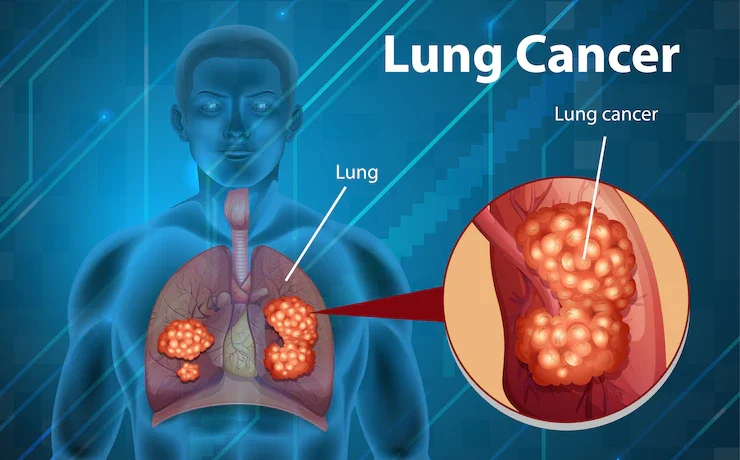
Lung Cancer
Lung cancer is a severe illness that begins with the uncontrolled development of abnormal cells in the lungs that develop into tumors, which hinder the flow of air and can further migrate to other organs, hence becoming the most common cause of death due to cancer in the world. It has two primary types: non-small cell lung cancer (NSCLC), and small cell lung cancer (SCLC), which is also fast-growing and early spreading.
The most observable symptoms, which are evident at an early stage, include persistent cough, chest pains, difficulty in breathing, presence of blood in the spit, weight loss, fatigue, and frequent lung infections. The success of treatment can be significantly enhanced in the case of early detection, particularly with the help of low-dose CT scans. Today, in this blog, we will figure out about lung cancer, its types, symptoms, causes, and treatment in detail. Have a look at the information given below.
Lung Cancer: An Overview
The development of lung cancer starts with the abnormal growth of lung cells, which increase exponentially to create tumors that usually obstruct the breathing process, besides spreading to other organs of the body. It claims a life of about 1.8 million people annually and is a big concern to individuals who desire to live a healthy and beautiful life. The two cancerous types include non-small-cell lung cancer (NSCLC) and small-cell lung cancer (SCLC), which is quite fast.
Smoking is one of the leading factors that is highly responsible for causing cancer. Along with air pollution, radon and asbestos, and genetic factors also play a vital role in doing so. Some of the most common symptoms include chest pain, chronic cough, hemoptysis, dyspnea, fatigue, and weight loss. When there is a cancer patient, then his/her Survival can be improved through early detection, and this can be done through low-dose CT scans in particular.
Small Cell Lung Cancer
Small cell lung cancer (SCLC) is a type of lung tumor that grows rapidly. It begins in the airways and progresses with high speed and spreads to the liver, lymph nodes, adrenal glands, bone, and brain. Nearly 99 percent of the SCLC cases are associated with smoking. Most of them are already at an advanced stage at the time of diagnosis. Treatment is usually chemotherapy and radiation with or without immunotherapy, and in early cases may involve small surgery. The first responses are intense, but the recurrence rate is high, and the overall survival at 5 years is approximately 7 percent.
Non-Small Cell Lung Cancer
The non-small cell lung cancer (NSCLC) is the most common lung cancer that is found in people and comprises around 80-85% of the cases. It is subdivided into three kinds of groups such as adenocarcinoma, squamous cell carcinoma, and large cell carcinoma. It develops slowly as compared to small cell lung cancer, and during its initial stages, it is usually asymptomatic and does not show any kind of symptoms such as chest pain, frequent cough, or shortness of breath. Smoking is the primary cause of lung cancer, and the rest are exposure to radon, asbestos, and air pollution. The treatment for this kind of lung cancer is chemotherapy, surgery, radiation, immunotherapy, and targeted therapy, depending on its stage and molecular markers. The survival is much better when it is diagnosed early. So be careful if there is any mention of symptoms or exposure to these things.
Causes of Lung Cancer
Well, there are various kind of reasons and factors that causes lung cancer and make a person prone to it. So it is important to know what they are in order to stay away from all these. Have a look at the causes given below.
-
Tobacco Smoking
Lung cancer is a result of smoking cigarettes in 80-90 per cent of cases. Tobacco smoke contains poisonous chemicals that destroy lung cells with time, leading to DNA mutation. The greater and the longer you smoke, the greater the risk. Even late quitting can minimize, but not get rid of, the risk.
-
Secondhand Smoke
Lung cancer also results from breathing the smoke of others. Sidestream smoke is composed of more than 4000 chemicals, 69 of them being carcinogens. Children and people exposed at home or work may be hurt even though they are non-smokers.
-
Radon Gas
Radon is a natural radioactive gas that is emitted by soil and rocks. It is able to build up in households. The risk of lung cancer gets high after exposure with time, only after smoking. Therefore, indoor air should be tested to limit exposure.
-
Asbestos Exposure
Exposure to asbestos, such as during construction or shipbuilding, may result in lung cancer or mesothelioma by breathing the fibers. There is a greater risk when it is used together with smoking. The use of asbestos in industries has been banned; however, older buildings are still dangerous. So don’t get in touch with such hazardous things.
-
Workplace Carcinogens
There are some other kinds of chemicals, such as arsenic, chromium, nickel, silica, uranium, diesel exhaust, and beryllium, which increase the risk of lung cancer. The people who work or are near mines, factories, and construction sites are prone to lung cancer. This even gets worse when it is accompanied by smoking.
-
Air Pollution
Lungs can also get harmed by vehicle exhausts, industry, and fuel burning in the open air over the years. Research indicates air pollution is a causative factor of lung cancer in approximately 5-8 percent of worldwide cases.
-
Chest Radiation
Previous chest radiation (due to diseases such as lymphoma or breast cancer) may also predispose one to lung cancer, particularly those who are smokers.
-
Genetics & Family History
Lung cancer is also hereditary. Mutations inherited, such as EGFR or DNA repair genes, raise the risk by about twofold. Even non-smokers can be defenseless in the hands of genetics.
-
Chronic Lung Disease
Chronic diseases of the lung, including COPD, fibrosis, or recurrent infections, increase the risk of lung cancer. The chronic inflammation and lung damage promote the changes to cancerous cells.
-
Diet, Lifestyle & Supplements
Risk can be increased by poor diet, insufficient exercise, and some supplements, such as high-dose beta-carotene in smokers. Poor living habits have the capacity to facilitate inflammation in the lungs, which exposes the cells to greater damage..
Signs of Lung Cancer
In the case of the signs of lung cancer then the most important warning sign is a cough that does not go away or worsens, including the coughing of blood or rust coloured mucus. Additional symptoms include chest pains when coughing or breathing, difficulty in breathing, frequent lung infections, hoarseness, unexplained weight loss, fatigue, and the acquisition of new wheezing. In such a kind of signs or have observed in somebody, then you should not waste your time and visit the doctor as early as possible.
Lung Cancer Symptoms
Here are some of the symptoms of lung cancer, which are mentioned below. Have a look at them one by one. If you have noticed, then connect with the doctor on a prior basis.
1. Persistent Cough
A persistent cough that won’t disappear or keeps getting worse. It can be mistaken for a common cold, yet it takes weeks, and it is usually the initial indication.
2. Hemoptysis
Even a little bit of blood or rust-colored phlegm in your cough can be an indication of a severe lung problem and needs to be checked out by a doctor at once.
3. Chest Pain
A tumor can compress the surrounding tissues and cause constant, aching chest pain, especially when coughing, deep breathing, or laughing.
4. Difficulty in Breathing
Difficulty in breathing after normal exercise or in daily activity arises because of tumors that obstruct the airways or lead to fluid around the lungs.
5. Frequent Lung Infections
A persistent bronchitis or pneumonia that does not completely clear up could be an indication of a deeper disorder of the lungs, such as cancer.
6. Wheeze or Hoarseness
Vocal cord or airway cancer may result in hoarseness, wheezing, or hoarse breath, lasting longer than a normal cold
7. Un-Explained Weight Loss
The early warning sign of cancer may be significant weight loss or loss of appetite without diet and exercise alterations.
8. Fatigue or Weakness
Constant fatigue, which is unable to subside even after sleep, may be the result of the influence of cancer on the immune and metabolic system
9. Nail Clubbing
The results of insufficient oxygen (lung disease, including cancer) may cause enlarged fingertips and curved nails (“clubbed nails”).
Lung Cancer Treatment
The right approach for a safe and healthy body
Here are some of the preferred and common treatments of lung cancer that are highly sought by people suffering from it. Have a look at the various types of lung cancer treatments given below.
1. Surgery
In the early stages of lung cancer (usually NSCLC), the tumor can be surgically removed: in part of the lung (wedge resection), an entire lobe (lobectomy), or the entire lung (pneumonectomy). This is therapeutic in cases where cancer has not metastasized, and in most cases, safe for healthy patients.
2. Radiation Therapy
Radiation involves the destruction of cancer cells and the shrinking of tumors by the use of high-energy beams. It is applied alone in the case of surgery impossibility or in combination with chemotherapy (chemoradiation). The more advanced types, such as SBRT and proton therapy, have greater targeting and fewer side effects.
3. Chemotherapy
Chemotherapy is the treatment involving the use of drugs that kill off fast-growing cancer cells within the body. It is used before surgery to shrink tumors, after surgery to keep them away (adjuvant), or as a monotherapy in advanced cases of small-cell and non-small cell lung cancer.
4. Immunotherapy & Targeted Therapy
Targeted therapy destroys certain genetic alterations in cancer cells (e.g., EGFR, ALK). Immunotherapy is a treatment that makes the immune system fight cancer with the help of checkpoint inhibitors such as pembrolizumab or nivolumab. These are particularly useful in advanced or metastatic NSCLC
5. Palliative Supportive Treatments
When there is no chance of cure, the physician aims at relief, such as decompression of fluid accumulation by thoracentesis, airway clearance by bronchoscopy and stents, and comfort care. These assist in enhancing breathing, alleviating pain, and preserving quality of life
Stages of Lung Cancer
We have discussed the 4 stages of lung cancer below. Have a look at them to know the things in detail.
| Stage 1 lung cancer | Stage 1 lung cancer is an early, localized cancer in which a small tumor, no more than 5cm, is located in a single lung with no lymph node involvement or distant metastases (T1-T2a, N0, M0). It is usually cured by surgery. It has a good chance of survival when detected early. |
| Stage 2 lung cancer | In stage 2 lung cancer, the tumor gets bigger than 3-5cm or invades the local lymph nodes (N1), but not other parts of the body (M0). It can include the structures that are close to them, such as the bronchi or the pleura. This initial phase can be surgically treated in some cases, and chemotherapy or radiation is used after the surgery. |
| Stage 3 lung cancer | Stage 3 lung cancer is regarded as locally advanced, and this means that the cancer has traveled to other body parts, including local lymph nodes or chest tissues, but not to other organs that are very far away. It has substages: 3A, 3B, and 3C. The therapy has been mostly linked to radiation, chemotherapy, immunotherapy, and surgery in other cases. |
| Stage 4 lung cancer | The fourth stage of lung cancer, or metastatic lung cancer, means that this disease has spread not only within the lungs but also to other distant organs (other lung, brain, bones, liver). It is normally incurable, but treatment, including chemotherapy, targeted therapy, immunotherapy, radiation, and palliative care, can slow it and reduce its symptoms. |
Sum up!
This was all about lung cancer and all other major things related to it. If you feel like you are getting prone to lung cancer or your loved one is in danger, get in touch with the doctor as early as possible. After a certain stage, it becomes impossible to treat the lung cancer, and the remains later are grief and sorrow. So, maintain a healthy lifestyle, quit bad habits, and embrace the right things that can keep you safe and secure.


